|
The 1849 California Gold Rush, originating in northern
California, had further grave consequences for Native American groups throughout California. The rapid decimation
of Native American populations in northern locations cut off centuries-old trading relationships.
As the influx of gold seekers accelerated, many of these disillusioned immigrant
miners filtered into and settled (primarily as farmers) in the Central Valley
and southern California. To make the most desirable land available to the European
settlers, the U.S. government began a program of relocation
of the Native American inhabitants.
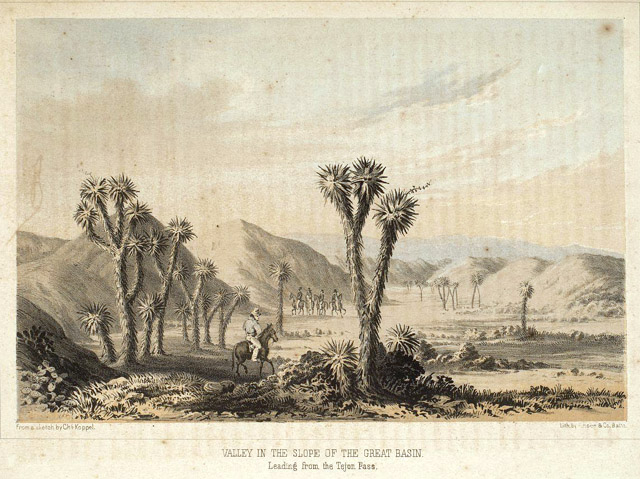
In 1854, the Sebastian Reservation and nearby Fort Tejon were built in the Tehachapi Mountains, which form the western border of the Antelope Valley. According to the U.S. Department of the Army, their purpose was to "protect the Indians." By 1864, most of the 1,000 people who had been "relocated" to Sebastian had deserted the reservation. Some individuals and families returned to the Antelope Valley and the Tehachapi vicinity, where they formed small communities and attempted to continue traditional cultural practices to the limited degree to which it was possible. In August 1864, the Sebastian Reservation was closed, and the remaining Native Americans were tranferred to Tule River Reservation.
During the mid to late 1800s, when population of local Native American groups was sparse,
peoples of the Chemehuevi Tribe (whose own territory lies further east and
north), visited and utilized Antelope Valley and its vicinities to expand their
hunting and gathering opportunities, particularly during times of drought.
Antelope Valley Native American Peoples
The Spanish Arrive << Previous | Next >> Recent
and Current Times
|